Expressing and Storing Breast Milk: A Calm, Practical Guide
Whether you are heading back to work or simply want an occasional break, here is how to express, store and use breast milk safely — the timings, the kit, and the small tricks that make it far less overwhelming.
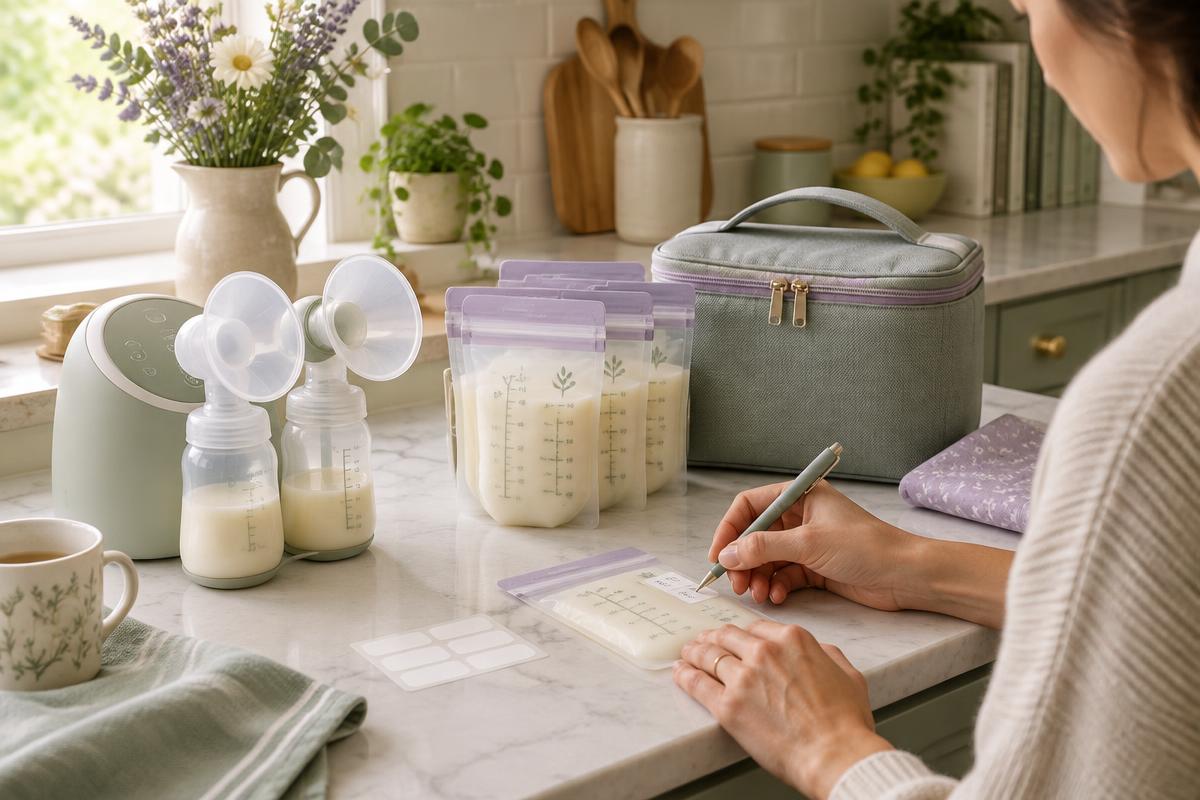
There comes a point for many breastfeeding families when someone else needs to feed the baby. Perhaps you are returning to work, perhaps you would like your partner to take a night feed, or perhaps you simply want the freedom of a few hours to yourself. Whatever the reason, expressing and storing breast milk is a skill — and like every feeding skill, it looks more complicated from the outside than it feels once you have done it a few times.
This guide covers why and when mothers express, how to hand express and pump, and how to store, thaw and serve milk safely. The storage guidance below follows the US CDC recommendations for healthy, full-term babies. Premature or medically vulnerable babies may need a different plan from their care team. Other countries may publish different guidance; follow the advice applicable to your baby and setting.
Why mothers express
There is no single right reason, and yours may change from week to week:
- Returning to work or study while continuing to breastfeed
- Letting a partner or grandparent share a feed — and the night shift
- Relieving fullness when your baby sleeps longer than your breasts expected
- Building a small freezer stash for peace of mind
- Feeding a baby who cannot yet latch, including babies born early
Ways to express
Hand expressing
Hand expressing needs no kit, costs nothing, and is surprisingly effective once you get the knack — especially in the early days, when colostrum is thick and volumes are small. Warm your hands, massage the breast gently, then cup it in a C-shape a few centimeters back from the nipple. Press back toward your chest wall, then compress and release in a steady rhythm, moving around the breast. It should never hurt. Ask your midwife to show you once; it is much easier to learn by watching than by reading.
Using a pump
Manual pumps are quiet, cheap and fine for occasional use. Electric pumps — single or double — are faster and kinder to your hands if you will be expressing daily. Whichever you choose, the fit of the flange (the funnel that sits over your nipple) matters more than the brand: your nipple should move freely in the tunnel without rubbing, and pumping should never hurt. A poorly fitting flange is the most common reason mothers conclude they "can't pump".
How much and how often
Milk production responds to milk removal, so when you are away from your baby, try to pump around the times your baby normally feeds. Newborns feed frequently, and a lactation consultant can help plan sessions for your situation. Pump output alone does not reliably show supply. Rather than setting one fixed amount for every hour apart, use your baby’s usual intake, growth and hunger cues to plan small bottles with the caregiver. Discuss concerns about intake or weight with the pediatrician, and leave clear storage and leftover-milk instructions.
Storing breast milk safely
Wash your hands before expressing, use clean food-grade containers with tight lids or breast-milk storage bags, and label the date before storing. Keep milk away from temperature changes in the refrigerator door. For healthy, full-term infants, CDC guidance gives these limits; your neonatal team may give stricter instructions for an early or medically vulnerable baby:
- Fresh milk at room temperature, 77°F (25°C) or colder: up to four hours; refrigerate promptly if not using it soon
- Fresh milk in a refrigerator at 40°F (4°C) or colder: up to four days, stored toward the back
- Milk in a freezer at 0°F (-18°C) or colder: about six months is best; up to twelve months is acceptable
- An insulated cooler with frozen ice packs: up to twenty-four hours during travel; then use, refrigerate or freeze within safe limits
- Freeze in small portions, such as 2–4 US fluid ounces (60–120 mL), and leave room for expansion
Defrosting and warming
The gentlest way to defrost frozen milk is overnight in the fridge. In a hurry, hold the container under warm running water or stand it in a bowl of warm water. A few rules are worth committing to memory:
- Never thaw or warm milk in a microwave; it heats unevenly and can burn
- Use refrigerated thawed milk within twenty-four hours from when it is completely thawed, not from when you removed it from the freezer
- Once milk is warmed or brought to room temperature, use it within two hours
- Never refreeze milk after it has thawed
- Use leftover milk within two hours after the baby finishes feeding, then discard it
- Milk does not need warming; if your baby prefers it warm, use a container of warm water and check before feeding
Your questions, answered
How long does breast milk last in the fridge?
For healthy, full-term infants, fresh milk can be stored in a refrigerator at 40°F (4°C) or colder for up to four days under CDC guidance. Keep it at the back, not in the door, and use the oldest milk first. Freeze promptly if you will not use it within four days. Do not rely on smell alone to decide whether milk is safe, and discard milk if storage conditions are uncertain. Ask your baby’s care team for stricter rules when prematurity or illness makes that necessary.
Can I mix milk from different pumping sessions?
Yes, with one precaution: chill freshly expressed milk in the fridge first before adding it to milk that is already cold or frozen, so you do not warm the older milk up. Label the container with the date of the oldest milk in it, and use that date for storage timings.
Why does my stored milk smell soapy or metallic?
Stored milk can sometimes smell soapy or metallic, but smell alone cannot tell you whether it was handled safely. Check the storage time, temperature and container, and discard milk if safe handling is uncertain. If your baby refuses safely stored milk, ask a lactation consultant or pediatrician for advice. Do not improvise heating or scalding as a routine solution without professional guidance, especially for a premature or medically vulnerable baby. CDC storage guidance provides the practical handling limits.
Do I need to sterilize breast pump parts?
Follow CDC pump-hygiene advice and your pump instructions: take apart and clean milk-contact parts after every use, then air-dry thoroughly. A suitable hot-water dishwasher cycle with heated drying or sanitizing may cover the sanitizing step; check the equipment instructions. Daily sanitizing is especially important if your baby is younger than two months, was born prematurely or has a weakened immune system. The care team may recommend additional precautions. Do not assume every part can be boiled, steamed or put in a dishwasher.
How much milk should I leave for a day at nursery?
There is no single amount that suits every baby or every day apart. Start with your baby’s usual feeding pattern and ask the pediatrician or a lactation consultant for help if you are unsure. Offer small portions responsively rather than pressuring a baby to finish a large bottle. Under CDC guidance, leftover milk can be used within two hours after the baby finishes feeding, then must be discarded. Label bottles clearly so a caregiver can follow the same plan.
A calm word to finish
If you are building a stash before returning to work, start two or three weeks ahead and add one short expressing session a day — after the morning feed works well for most mothers. A freezer drawer of small, labeled bags grows surprisingly quickly, and knowing it is there takes the pressure off those first days back.
Expressing is one of those things that feels like a faff for the first week and like second nature by the third. Start small — one session, one labeled bag in the freezer — and let your routine grow from there. If you are still in the newborn days, our guide to the first two weeks of breastfeeding will help you get feeding established first, and our newborn sleep guide pairs well with planning those precious shared night feeds.
Written by
The Bloomymom Team
Moms, writers and friends who believe honest advice should always come with kindness.
Enjoyed this? Join our Sunday letter
Plus our free Hospital Bag Checklist.